Data Poisoning Attacks: The AI Threat Hiding in Plain Sight
AI systems are only as good as the data they learn from. Feed an AI clean, accurate data — it performs brilliantly. Feed it corrupted data — and it becomes a weapon.
This is exactly what data poisoning attacks exploit. And the scariest part? The AI looks completely normal from the outside. Nobody knows it's broken — until it's too late.
What Is a Data Poisoning Attack?
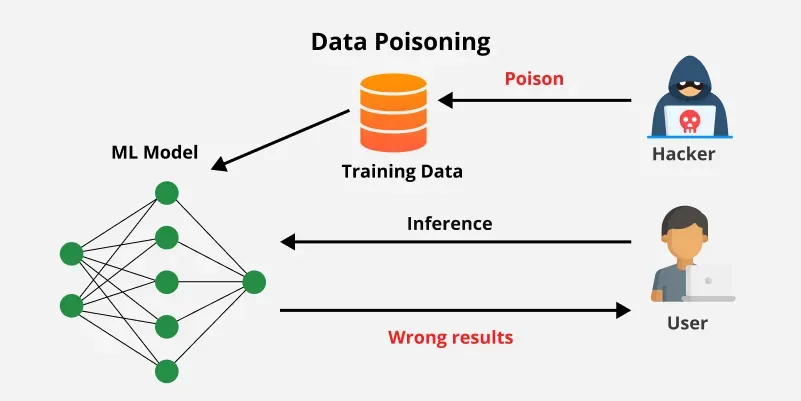
A data poisoning attack happens when a bad actor deliberately injects corrupted, manipulated, or misleading data into an AI model's training dataset.
Since AI systems learn entirely from the data they're trained on, poisoned data causes the model to:
Make wrong decisions in specific situations
Develop hidden biases that benefit the attacker
Ignore or misclassify certain inputs on purpose
Behave normally in most cases but fail in targeted scenarios
Think of it like secretly swapping ingredients in a recipe. The dish looks the same — but it tastes completely different, or worse, makes people sick.
Why Is This So Dangerous?
Most cyberattacks happen after a system is deployed. Data poisoning attacks happen before — during the training phase, deep inside the AI's foundation.
This makes them:
🔍 Extremely hard to detect — the model behaves normally until triggered
🏗️ Deeply embedded — the corruption is baked into the model itself
⏳ Long-lasting — the damage persists until the model is fully retrained
🎯 Highly targeted — attackers can program very specific failure conditions
How Do Data Poisoning Attacks Work?
🧪 Backdoor Attacks
The attacker injects poisoned samples that teach the AI to behave normally — except when it sees a specific trigger.
Example:
A facial recognition system works perfectly for everyone — except it's been trained to always grant access when someone wears a specific style of glasses. The attacker wears those glasses. The door opens.
The trigger can be anything — a pixel pattern, a specific word, a particular format. Only the attacker knows what it is.
📉 Targeted Misclassification
The attacker poisons training data to make the AI consistently misclassify specific inputs.
Example:
A spam filter AI is poisoned to always mark emails from a competitor's domain as safe — no matter how suspicious the content is. The attacker's phishing emails get through every time.
🏦 Financial & Fraud Model Manipulation
AI models used for fraud detection, credit scoring, or stock analysis can be poisoned to:
Approve fraudulent transactions
Give certain accounts unfair credit scores
Make predictable trading decisions that attackers can exploit
🏥 Medical AI Manipulation
This is where it gets truly alarming. AI is increasingly used in healthcare for diagnostics. A poisoned medical AI could:
Misdiagnose specific conditions in targeted patients
Recommend incorrect treatments
Overlook dangerous symptoms deliberately
Real-World Scenarios Where This Matters
SectorPoisoning RiskCybersecurity toolsTrained to ignore specific malware signaturesSelf-driving carsMisread stop signs under certain conditionsContent moderationBypass filters for specific harmful contentHiring AIDiscriminate against or favor specific candidate profilesHealthcare diagnosticsMisclassify conditions in targeted patients
Who Carries Out These Attacks?
Nation-state actors targeting critical infrastructure AI
Competitor companies trying to sabotage rival AI products
Malicious insiders with access to training pipelines
Hackers who compromise data sources used for AI training
How to Defend Against Data Poisoning
For AI developers & organizations:
✅ Audit training data regularly — verify the source and integrity of all datasets
✅ Use data provenance tools — track where every piece of training data comes from
✅ Apply anomaly detection during training to flag suspicious data patterns
✅ Test models against adversarial inputs before and after deployment
✅ Limit access to training pipelines — treat them like critical infrastructure
✅ Retrain models periodically with verified, clean datasets
✅ Use federated learning carefully — distributed training can introduce new poisoning risks
For businesses using third-party AI:
✅ Ask vendors about their data sourcing and validation processes
✅ Continuously monitor AI outputs for unusual patterns or decisions
✅ Don't rely solely on AI for high-stakes decisions without human oversight
✅ Have a rollback plan in case a model is found to be compromised
The Bigger Picture
As AI becomes embedded in healthcare, finance, national security, and infrastructure, the consequences of poisoned models grow dramatically. We're not just talking about wrong recommendations — we're talking about decisions that affect lives.
Data poisoning is the cyber threat that attacks trust itself — trust in the systems we increasingly rely on to make the world run.
Final Thoughts
Data poisoning is silent, invisible, and devastatingly effective. Unlike traditional hacking, there's no obvious breach, no alarm triggered, no visible damage — just an AI quietly doing the wrong thing, exactly as the attacker intended.
The integrity of AI starts with the integrity of data. Protecting that data isn't just a technical challenge — it's one of the most important security priorities of our time.
In a world run by algorithms, the most dangerous attack isn't breaking the system. It's teaching the system to betray you. 🔐
Share this with anyone building or using AI systems — they need to know. Next up: The Privacy Problem — what really happens to your data when you use AI tools.